Understanding American, Fractional, and Decimal Odds: What's the Difference?
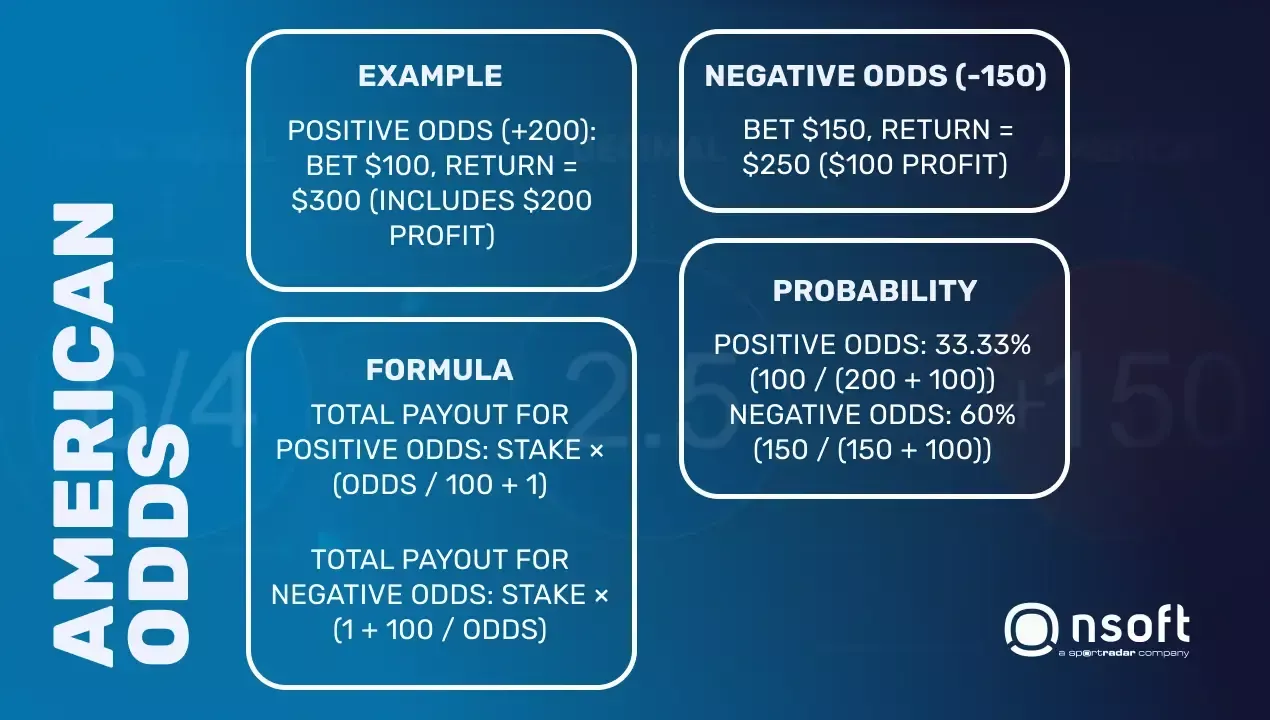
When it comes to betting, understanding the different types of odds is crucial for making informed decisions. The three primary formats are American, fractional, and decimal odds. Each format offers a distinct way to represent the same information: the potential return on a bet. American odds, often seen in sportsbooks, are expressed as either positive or negative numbers. A positive number denotes the profit on a $100 bet, while a negative number indicates the amount you need to wager to win $100. For example, +200 means a profit of $200 on a $100 bet, while -150 means you would need to bet $150 to win $100.
Fractional odds are commonly used in the UK and are displayed as a fraction, such as 5/1. This means that for every $1 you bet, you can win $5 in profit. Conversely, decimal odds simplify the process even further by representing the total return, including the original stake, as a single number. For instance, odds of 6.00 in decimal format mean a total return of $6 for every $1 wagered. Understanding these different odds formats can help bettors evaluate risk and reward, ensuring they make the best decisions for their gambling patterns.
Don't miss out on great savings! Use our duel promo code to enjoy exclusive discounts on your next purchase. Act fast and take advantage of this limited-time offer!
How to Calculate Payouts: A Guide to Odds Formats
Calculating payouts is essential for anyone involved in betting, whether it's sports, casino games, or other forms of gambling. Understanding odds formats is crucial for determining how much you stand to win. There are three primary formats for odds: fractional, decimal, and moneyline. Each format expresses the potential payout differently, but they all convey the same information. To get started, you must first identify the odds format being used. Here’s a brief overview:
- Fractional Odds - Commonly used in the UK, these odds display the potential profit relative to your stake. For example, 5/1 means you will win $5 for every $1 wagered.
- Decimal Odds - Popular in Europe and Australia, these show the total payout, including your initial stake. A decimal of 6.00 means you will receive $6 for every $1 bet, which includes your original stake.
- Moneyline Odds - Often seen in the US, these odds indicate how much you can win based on a $100 bet. Positive odds (e.g., +200) show how much you’ll profit on a $100 bet, while negative odds (e.g., -150) indicate how much you need to wager to win $100.
Once you’ve determined the odds format, calculating your potential payout is straightforward. For fractional odds, multiply your stake by the numerator and divide by the denominator. For example, if you wager $10 on 5/1 odds, your profit would be ($10 * 5) / 1 = $50, plus your original stake of $10, totaling $60. In the case of decimal odds, the formula is simply to multiply your stake by the decimal. So, for a $10 bet at 6.00 odds, your payout would be $10 * 6.00 = $60. Lastly, for moneyline odds, positive odds indicate profit based on a $100 bet, while negative odds require a calculation of stake = $100 / (odds/100) to find what you need to bet to win $100. Understanding these calculations will help you make more informed betting decisions.
What Are Implied Odds and Why Do They Matter in Betting?
Implied odds are a crucial concept in the world of betting, representing the probability of a particular outcome as suggested by the odds provided by bookmakers. Unlike traditional odds, which inform bettors of their potential payout, implied odds take it a step further by translating those odds into a percentage that reflects the likelihood of that event occurring. For example, if a team has odds of 2.0, the implied odds indicate a 50% chance of winning. Understanding these probabilities is essential for bettors who wish to make informed decisions based on value rather than just the surface appeal of odds.
So, why do implied odds matter in betting? They play a pivotal role in helping bettors assess value and compare it against their own evaluations of an event's outcome. By calculating implied odds, bettors can determine whether the bookmaker's assessment aligns with their own prediction. If a bettor believes that the true probability of an outcome is greater than the implied odds suggest, it may indicate a profitable betting opportunity. Conversely, if the implied odds are significantly higher than the bettor's assessment, it may be wise to refrain from placing a wager. In essence, understanding implied odds not only enhances a bettor's strategy but also fosters responsible gambling practices.